As mentioned in my previous post, The
Plenty Method helps you whip up sumptuous meals on a moment’s notice. I call
these “quick plates”. The idea is to stock a pantry with a plentiful yet simple
collection of scratch ingredients called “Master Ingredients.” Then, develop a
repertoire of “un-recipe recipes” that reduce the time it takes to get food on
the table. This way, you’ll always have great food on hand and you’ll know what
to do with it. Which makes the question “what to eat” much easier to answer and
the statement “there’s nothing to eat” non-existent.
Over the years I’ve developed some
short cuts to expedite time spent in the kitchen. The curry described in the
previous post is more flavorful with a little garlic and ginger added. But
peeling and chopping those takes precious time, time you may not want to spend.
Plus, you may not always have those ingredients on hand. What to do about this
dilemma? Freeze it! Here’s how:
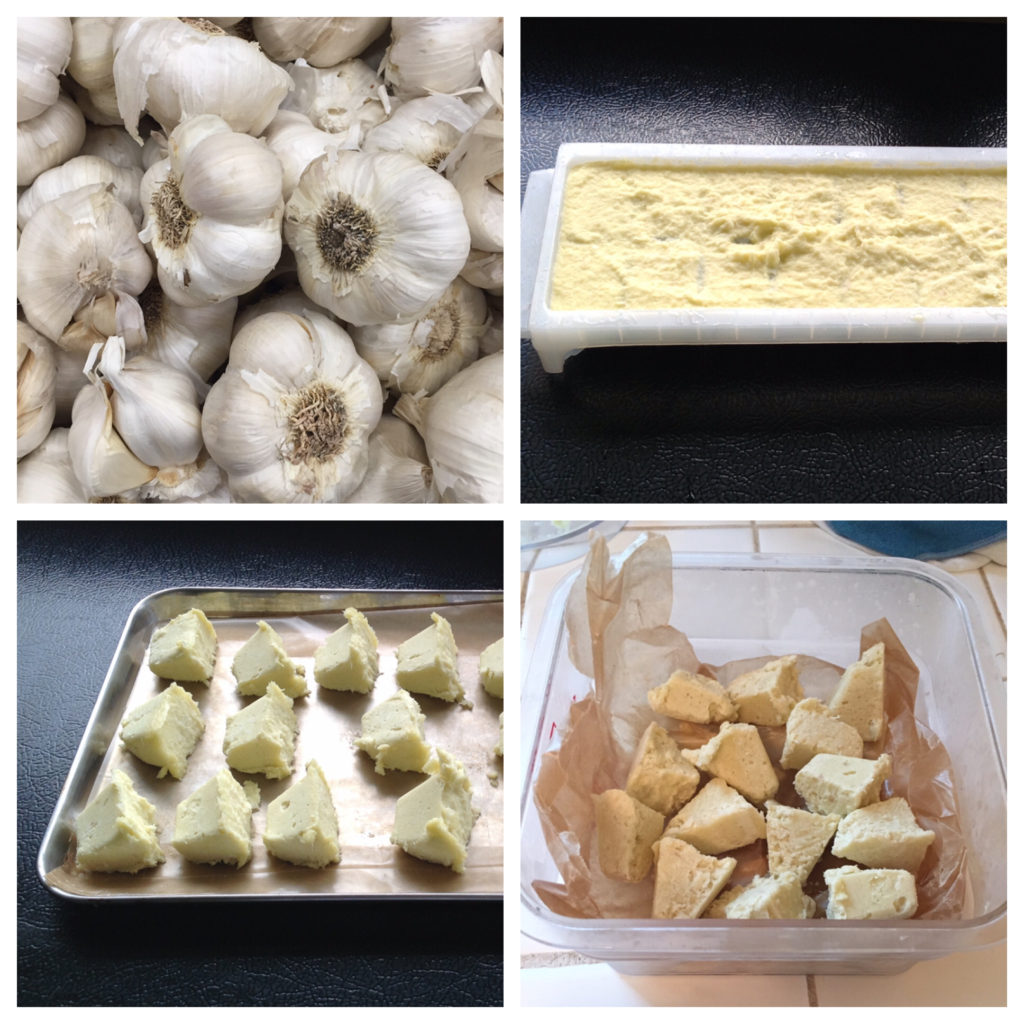
Start by buying a couple of pounds each
of garlic and/or ginger. Then, peel and coarsely chop it and drop it in a
blender or a food-processor. Blend until it becomes a smooth paste then add a
little vegetable oil so that it binds together
and becomes spreadable. Using a spatula, put the mixture into ice cube trays and freeze
for a day or two. Then, thaw until the cubes are loose enough to be scooped out
with a small knife (I find a butter knife with a rounded edge works best). Place
them on a cookie sheet and re-freeze. Then place in a plastic container with an
airtight lid. I cut the cubes in half and put waxed or parchment paper in
between the layers. You don’t have to thaw these out before using. Just chop
them up a bit and use them as if they were fresh.
You can do this with lemon juice,
whipping cream or fresh herbs. Having these “flavor cubes” on hand gives you
the ability to up-level your cooking from good to great with minimal effort. Easy
“un-recipes” make cooking a lot more pleasurable, too!
Now that you can buy coconut milk for a third or half of retail cost, (please see previous post), you might consider keeping an extra supply in your pantry. A plentifully stocked larder encourages you to get in the kitchen and experiment a little. So, what can you do with all that coconut milk?
Whip up a curry using The Plenty Method! While recipes are useful for ideas and inspiration, their requirements for exact measurements and ingredients can often be quite restrictive and time consuming. The “Y” in Plenty means “Yum: the un-recipe recipe.” Break loose of cooking rules, formulas, shoulds and musts and experience new freedom in the kitchen!
So here is how to make a simple curry sauce using an “un-recipe recipe”. You can mix this sauce with lentils, roasted or sautéed vegetables, pineapple, noodles, rice, tofu, tempeh, beans, shrimp. Or, cooked chicken, beef, pork or lamb (which I purchase from a local farmer). The combinations are endless. And it is surprisingly easy to make this sauce.
To start, find a large skillet, sauce pan or Dutch oven. Dice an onion and sauté it in butter, vegetable, or coconut oil that has started to bubble. Sauté the onion for a few minutes until it’s translucent. Then add about a tablespoon of curry powder or paste and some seasoning salt (my favorite are those made by Maggi). To that, add a can of undiluted, unsweetened coconut milk and stir until it bubbles.
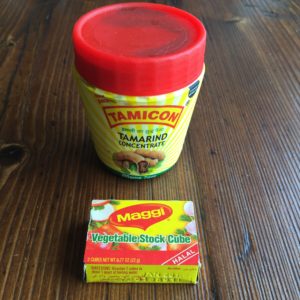
If you have some tamarind paste or concentrate, add slightly less than a tablespoon. In The Plenty Method, tamarind is what we call a “flavor burst”. It’s a concentrated flavoring that kicks the flavor up a notch and makes humble ingredients more interesting. If you don’t happen to have any tamarind on hand, don’t worry. But next time you are at an international food market or Asian grocery store, consider picking some up. It adds a lovely tart and tangy complexity to many dishes. Another flavor burst you might like to add is a splash of aged sherry vinegar. Just a touch adds yet another layer of lovely flavor. Add a touch of hot sauce if you like your food spicy (my go-to is Sriracha). Some people like the flavor of fish sauce. If you do, add that if you have some.
If the sauce seems too thick, add some water. If it’s too thin continue to cook it down or stir in some corn or tapioca starch diluted in a small amount of water. Then voila! There’s your curry sauce, ready to use as suggested above. Along the way, listen to your senses; they will tell you what to do. If it tastes a bit flat, add more curry powder, tamarind or salt. And if you are in a hurry, you can forgo the onion and start with the coconut milk. My favorite way to eat this sauce is over roasted cauliflower served on a bed of brown rice and topped with roasted cashews. Nourishing and delicious fast food!
One of my goals is to help people learn how to whip up
something easy and delicious in the time it would take to get take-out or go to
a drive through. Having a plentiful supply of food on hand and a few “un-recipe
recipes” makes it much easier to cook on the fly. Try it, you’ll like it!
Tamarind makes an excellent flavor burst. I love Maggi seasoning salts.
Let’s say that you multiplied your food dollars three times by buying a 98 ounce can of coconut milk at a wholesale price (please see previous post). But what do you do with all that coconut milk once it’s opened? Naturally, you may worry that it will go to waste. And since grocery store shoppers are conditioned to buying small amounts of food frequently, buying a large amount of food less frequently might feel uncomfortable at first. But don’t worry – The Plenty Method will help you learn how to store the extra. That’s what the “N” in “Plenty” means: “New containers and making space”.
Opened coconut milk keeps in the refrigerator for about a
week or two, depending on how cold your fridge is. Store it in the main body of
the refrigerator where it is coldest. Since the coconut cream separates from
the coconut water, you’ll need to mix it first. The easiest way to do this is
to put it in a large pan and gently heat it. That melts the oil and makes it
easier to blend. To minimize the number of things to wash, consider whipping up
a quick curry (see next post). Then wash the pan!
Estimate the amount you will use before it spoils then
freeze the extra. I freeze it in pints. You can freeze the portions in zip-lock
bags because they lay flat (wait until the coconut milk is at room temperature
before pouring it into the bag). When you finish with the Ziploc bag, you can
keep it in the freezer. Then you won’t have to wash or throw the bag away every
time you divide coconut milk. If you don’t want to use plastic, try a
straight-sided canning jar. These prevent the milk from cracking the glass as
the liquid expands.
After the milk thaws out, it curdles a bit. To restore its creamy consistency, blend it for about thirty seconds. If you are interested in the food science around this, check out this Cook’s Illustrated article: https://www.cooksillustrated.com/how_tos/9034-storing-leftover-coconut-milk. To minimize containers to wash, blend it right in the bag with an immersion blender if you have one. Then dilute to desired consistency and pour the mixture into a glass bottle. Always give it a good shake before using as it does separate.
If all this seems too complicated, you can buy the coconut milk in 13 ounce cans at the restaurant supply store. You can still multiply your food dollars by about twice. But once you know how, it’s really not too much trouble to store a big can. Or, freeze just some of it. Children enjoy helping with this project, especially if they get to drink a hot-cocoa or fruit smoothie afterward. I find that children tend to be motivated by good things to eat, most adults, too!
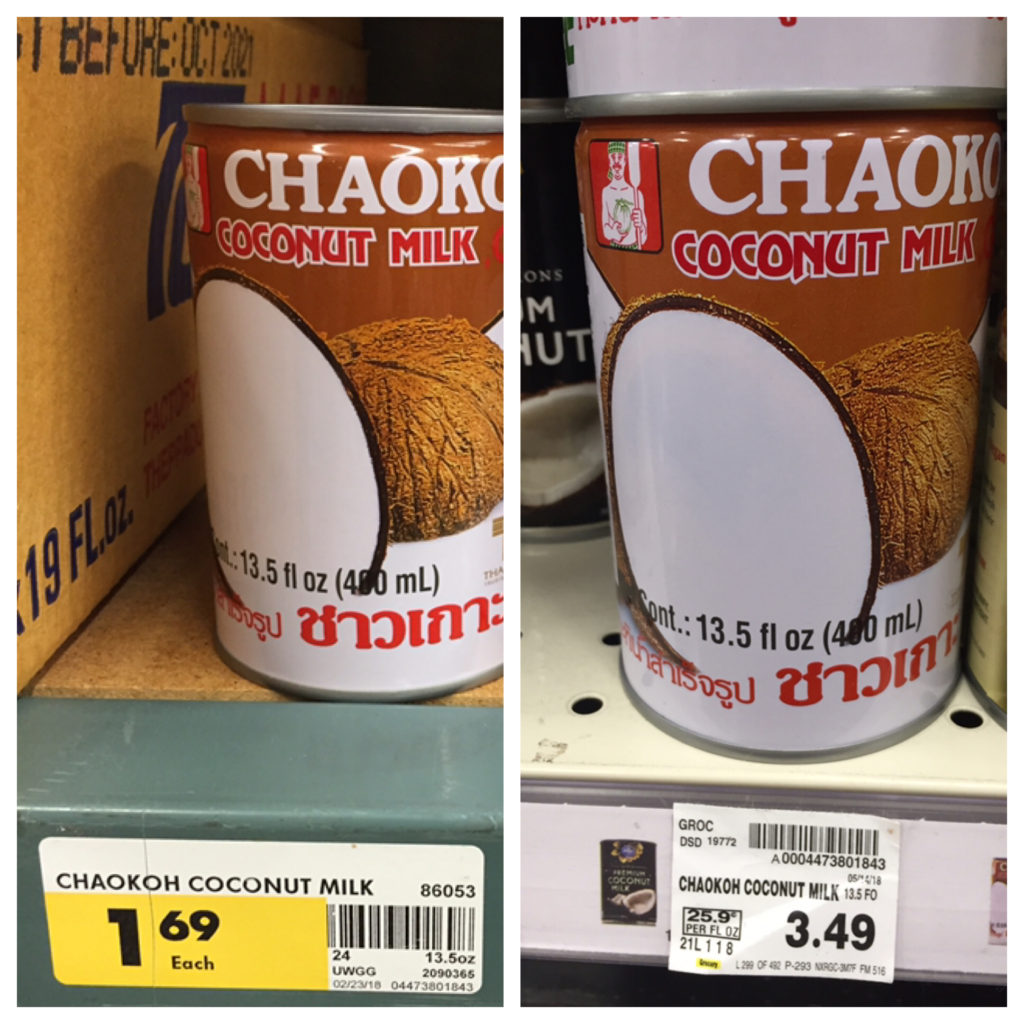
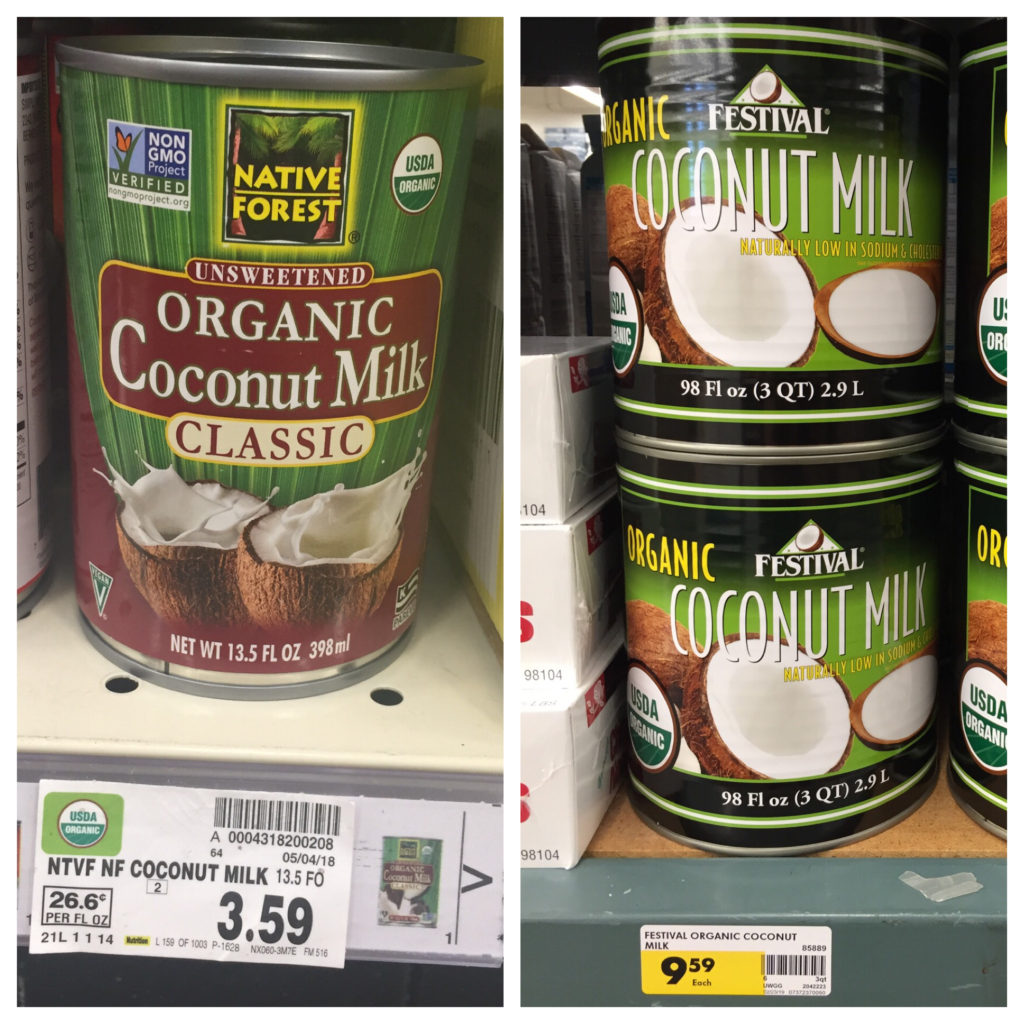
The wholesale versus retail price of coconut milk in a 13.5 ounce can.
I began working on The Plenty Method in 2008 when I was a
planning commissioner for the city of Wilsonville, Oregon. I specialized in
food and water because they are so fundamental to life. Slowly, I began to
worry that accessing uncontaminated/unadulterated food would become more
difficult and more expensive over time. Eating well was a priority, yet a healthful
diet consisting solely of organic and humanely food was already
cost-prohibitive.
Now, ten years later, I’ve finished articulating The Plenty Method. I’d like to help you learn how to access – and afford – the best food on the planet. Then you can have radiant health and experience more pleasure in life, too. The following is an example of how you can multiply your food dollars when you use The Plenty Method.
Lately, there’s been a lot of mention about how livestock contributes to greenhouse gases. So I’m trying to find non-dairy alternatives for milk. Coconut milk makes a surprisingly good substitute for cow’s milk and cream. The unsweetened concentrate comes in a can and when diluted with water in a one to one ratio, it has the consistency of milk. Use less water and it’s like cream. Coconut milk is creamier and silkier than cow’s milk. When mixed with other foods, the coconut flavor becomes mild or even diminishes. So far, I’ve tried it in my favorite creamy vegetable soup and a béchamel sauce (that I poured over roasted cauliflower). It’s fabulous in hot chocolate! Use it in curry and smoothies. Feel free to experiment, substituting it in recipes that call for milk or cream.
A 13.5 ounce can of organic coconut milk retails for around $3.59, or just shy of .27 cents per ounce. At the local wholesale restaurant supply store (where anyone can shop, no license required) a 98 ounce can sells for $9.59, or just shy of ten cents an ounce. When I buy it wholesale, I multiply my food dollars by almost three times. Multiplying your food dollars will make you feel quite wealthy. Having plentiful amounts of coconut milk on hand feels quite luxurious. Contributing to planetary health by reducing the use of dairy and increasing your purchases of organic food can make you feel happy, too. By the way, the “E” in The “Plenty” Method stands for “Easy-to-find-food-sources”. Our book, “The Joy of Plenty”, will show you how to find non-grocery store food sources so you can easily multiply your food dollars. And if you wonder what to do with that all that coconut milk, stay tuned for the next blog.
The Plenty Method helps you learn how to multiply your food dollars
Let’s
continue reading between the lines in the advertisement that Bayer/Monsanto
placed in The New York Times on Wednesday, March 27, 2019 (please see previous
post). The corporation placed this ad in response to the negative publicity being
generated from the 11,200 court cases winding their way through the legal
system. The plaintiffs allege that Roundup/glyphosate causes Non-Hodgkin Lymphoma,
a type of cancer.
The
advertisement states “Independent
regulatory agencies continue to assess glyphosate-based products and conclude
they can be used safely and that glyphosate is not carcinogenic. These include
not only the United States Environmental Protection Agency (EPA), but also the
European Food Safety Authority (EFSA), European Chemicals Agency (ECHA),
Australian, Canadian and Japanese regulatory authorities, as well as the Joint
Food and Agriculture Organization of the United Nations/World Health
Organization Meeting on Pesticide Residue (JMPR).
That’s
quite a lineup of societal authorities, very convincing. But . . . . let’s read
between the lines to reveal what the ad doesn’t say. Remember, a lie can be
told by omitting the other half of the story, the contextual framework. Here is what Bayer/Monsanto doesn’t want you
to know:
That
one of the tactics agribusiness uses is to infiltrate regulatory agencies and
other institutions around the world with their own executives. These people
then become high-level officials in the regulatory agencies/institutions that
oversee the agribusiness industries. Then these
executives use their power to influence the agency’s policy and regulations. Other
terms for this are “regulatory capture” and “revolving door”.
Keep in mind that governments create regulatory agencies to act in the
public’s interest and to protect the public’s health. When the corporations capture the agencies, the
commercial interests of big business (via lobbying groups) become primary and
the public’s interest and health, secondary.
Bayer/Monsanto also doesn’t want you to know that
they genetically modified food so that it can withstand increasingly strong
applications of Roundup/glyphosate. Now the pesticide’s residues are appearing
in many foods. Roundup is being detected more and more in our water, air and
soil. It’s everywhere.
We need more people to recognize the deception and destructive dynamics these large corporations use to keep us blind and unremittingly under their control. Then we can say a loud and resounding NO to this unethical use of power that represses and disregards the public’s voice. We can say NO to government captured by corporate power. We can do this by refusing to buy the corporation’s products. In the case of Bayer/Monsanto/Roundup, this means avoiding genetically modified food and if possible, buying organic food instead. The truth, the whole truth, and nothing but the truth is that, we, the people, can speak truth to power, one buying decision at a time.
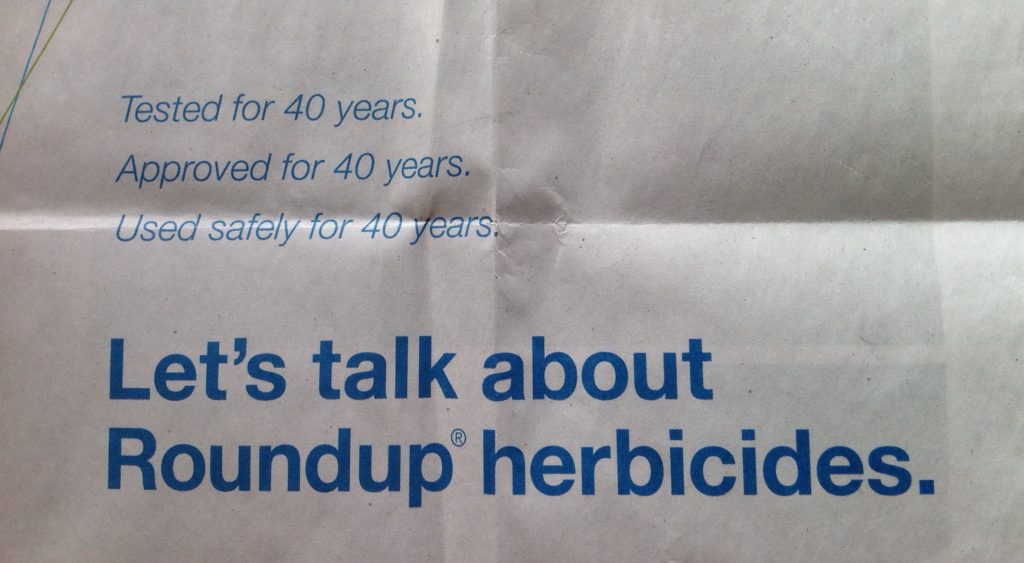
A couple of weeks ago when I was thumbing through The New York Times, I couldn’t help but notice the blue and white full-page advertisement placed by Bayer/Monsanto in defense of Roundup/glyphosate. The heading reads “Let’s talk about Roundup® herbicides”. Oh no!
The company is launching a campaign to convince the public that the pesticide won’t harm our health. When big corporations see their profits are threatened, (please see previous two posts for explanation of this) they launch massive campaigns designed to manipulate the public’s opinion. These campaigns will be filled with propaganda and disinformation, including paid ads disguised as news meant to create doubt. An unsuspecting reader might read these ads and be convinced the stuff is safe enough to drink in a martini every night. And the corporation certainly doesn’t want you to know that most GMO food has been modified to withstand increasingly strong applications of the stuff, and that the pesticide is showing up in our food, soil, water and air with increasing frequency.
But here’s the thing: a lie can be
told via a “half-truth”. It’s lying by omission. It’s lying by presenting only
part of the story and omitting the full context.
So knowing that, let’s read the ad
between the lines:
“Glyphosate-based herbicides, which include most Roundup® products, are among the most rigorously studied products of their kind”. What they don’t want you to know:
That the chemical companies hire scientists to do the research necessary to get pesticides approved by regulators,[1] so the scientists are bought and paid for by the chemical companies. This naturally creates a conflict of interest dynamic, because the scientists will feel duty, obligation and loyalty to the authorizing power over them. The scientist might feel pressure to conform to the company’s objectives and standards. Under this pressure, the researchers often skew the findings, fail to question fundamental premises, and suppress awareness of contradictions so that the results favor industry profits over the public’s health. Then when agribusiness companies answer questions about pesticide safety, they can claim with authority that decades of scientific studies have shown the chemicals to be safe for human use and that no credible scientific evidence exists otherwise.
As you can
see, it’s all in the family – at least
in the feudalistic one, where the corporations are the overlords. So now you’ve
read between the lines and you know more of the truth than you did before.
Advertisement in The New York Times, Wednesday, March 27, 2019
I don’t generally consider myself to be a political type,
yet I can’t help but feel encouraged about the conversation I see shaping up
among the Democratic Party’s presidential candidates. Many are outlining a plan to revitalize rural
America by breaking up agricultural monopolies and restoring competition in
that sector.
Finally, someone (Cory Booker, Elizabeth Warren, Amy Klobuchar, and John Delaney) is acknowledging the damage done to rural America from industrialized farming practices and hyper-consolidation in agribusiness. Independent farmers, the backbone of our rural economy, are finding that their profits are rapidly disappearing. This is because big monopolies now control the cost of everything involved in the entire food production process. This process begins when a farmer plants a seed and ends when a shopper plucks an item off the grocery store shelf. Farmers are getting strangled from both the buy and sell sides of transactions. The inputs monopolies control the prices of the products the farmers buy to grow or raise food: seeds, fertilizers, pesticides, machinery, etc. On the sell side, the processor/distribution monopolies control the prices paid to farmers for their crops/livestock. These monopolies make it increasingly difficult for farmers and ranchers to run profitable businesses; they drive up the price of food for shoppers.
Is that too long and complicated? Then how about this, in
two simple words: corporatefeudalism. A difference between now and
centuries ago is that the overlords aren’t the aristocracy; it’s the corporations.
I felt another glimmer of hope that turned to excitement
after I read the best summary on corporate feudalism that I have ever read,
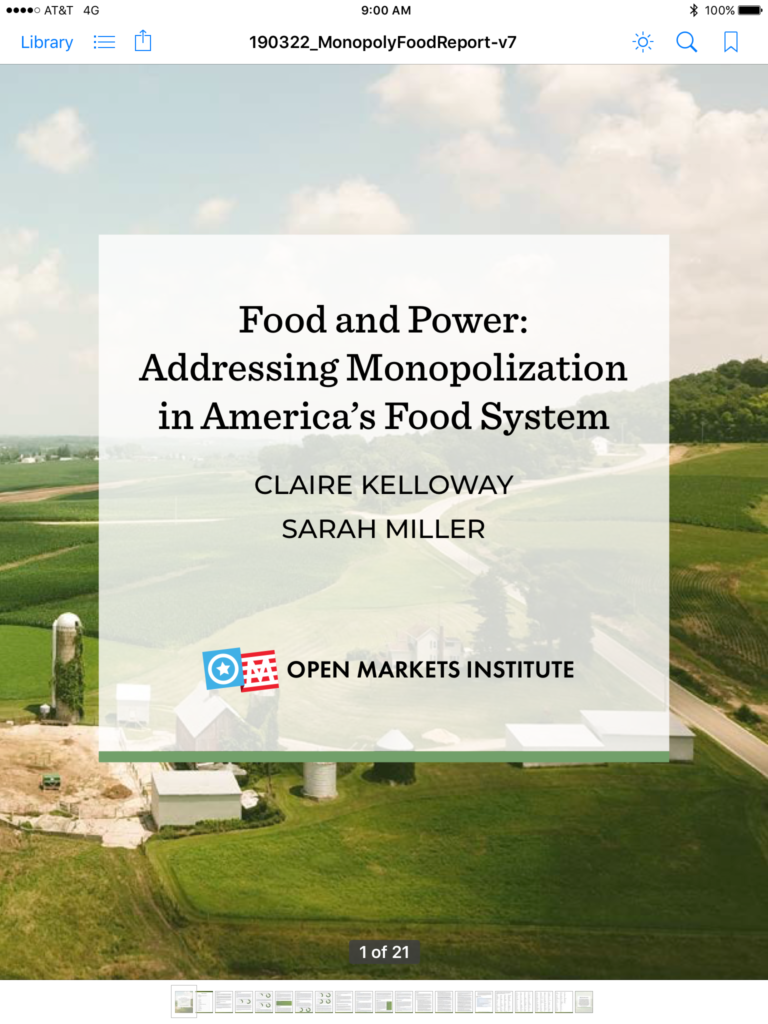
written recently by the Open Markets Institute. It’s titled “Food and Power: Addressing
Monopolization in America’s Food System”. They propose suggestions about how to
solve this problem on pages 12-16, take a look! We can mobilize as a society to
support these policy changes and transformation can occur. Check it out here: https://openmarketsinstitute.org/wp-content/uploads/2019/03/190322_MonopolyFoodReport-v7.pdf
It will take a lot more than breaking up agricultural
monopolies to restore economic vitality to rural America. It took fifty years
for those monopolies to develop and it may take that many years to undo them. Still,
dissolving them is a step in the right direction. The coming tsunami of job
loss due to automation, robotics, artificial intelligence and software are
enormous headwinds. So I approach the subject of breathing life into rural
America with cautious enthusiasm.
This upcoming election season presents a fabulous
opportunity for discussion and debate. I hope Republican candidates will also
join this conversation to weigh in on the issue of hyper-consolidation in the
agricultural sector (and other sectors, too). I look forward to lively dialogue
and bright lights shining in dark and dreary corners.
My faith in the American government has been somewhat
restored. And it feels invigorating, like a breath of fresh, floral spring air
filling up my senses. I haven’t felt such a glimmer of hope about our
government in years. Oh my, did I ever need that!
Why am I feeling optimistic? Because of the
Bayer/Monsanto/Roundup trials (please see previous post). Apparently there are
11,200 other similar cases waiting to go to trial. So, we can expect this topic
to be circulating in the news for quite sometime.
But this is more than just a news story. The stories reveal a deeper truth: that the United States’ judicial system is inadvertently taking on the role of protecting the public’s health, because the appropriate regulatory agencies have failed to do so. Everyone plays a role in this current situation. The regulatory system holds regulators in a vice-like grip of science versus politics, and economics versus health. The public’s demand for inexpensive food and the government’s desire to decrease hunger by making cheap food available contributes to the problem. Ethical considerations prohibit testing pesticides on humans. Regulatory agencies around the world are infiltrated with executives from the agribusiness industry so there are conflicts of interest. All this results in an ineffective and fundamentally flawed regulatory system.
The primary regulatory
bodies that oversee the public’s health – the Environmental Protection Agency,
the Food and Drug Administration, and the United States Department of
Agriculture – have all been emasculated to one degree or another because the corporations
greatly influence government functions at every level. The fact that 11,200
cases are now working their way through the courts reflects the failure of our regulatory
agencies.
The cases are also a
testament to the brilliance of our founding fathers. Their genius created a
checks and balances system that preserves the integrity of our government. The trials
demonstrate the moderation of power in action between the judicial, legislative
and executive branches of government. Unfortunately, the regulatory agencies
are under the jurisdiction of the executive branch so they can, and have become,
highly politicized.
The downside of the
judicial system acting as regulator is that they can respond only after the
fact, after the damage has already occurred. Judiciary is reactionary, not
proactive.
But who was it that said “better late than never“? I’ll take that breath of fresh air and hopefulness over nothing at all.
“I read the news today, oh boy” (to
quote the Beatles).
“Monsanto Ordered to pay $80 Million in
Roundup Cancer Case” (The New York
Times)
“Bayer Keeps Roundup Faith After Losing Second Trial” (Bloomberg)
“Jury Awards Over $80 Million in Roundup Exposure Case” (Wall Street Journal)
In case you haven’t read the story, here’s my
annotated version:
In a trial against Bayer/Monsanto, a US jury awarded
$80 million to a man who developed Non-Hodgkin Lymphoma after prolonged
exposure to Roundup. The jury found glyphosate/Roundup to be a substantive
factor in causing the cancer. They also found Bayer/Monsanto to be negligent by
failing to warn the public of the weedkiller’s cancer risk and failing to
properly research the safety of its product. The trial is thought to be a
bellwether case, helpful in determining the fate of 11,200 similar, pending
cases. This and a similar case last August are historic and precedent-setting
cases.
Or, an even shorter version: Bayer/Monsanto has been
taken to the whipping post. The American judicial system is increasingly taking
on the role of protecting the public’s health.
Bayer/Monsanto is not entirely at fault here. Over
the past 40 years since regulators approved glyphosate/Roundup, the company has
responded to the public’s demand for inexpensive food and the government’s
desire to prevent hunger. But as so often happens, greed sets in, ethics go out
the door, and corruption takes hold. The company has clearly crossed a line, or
several lines.
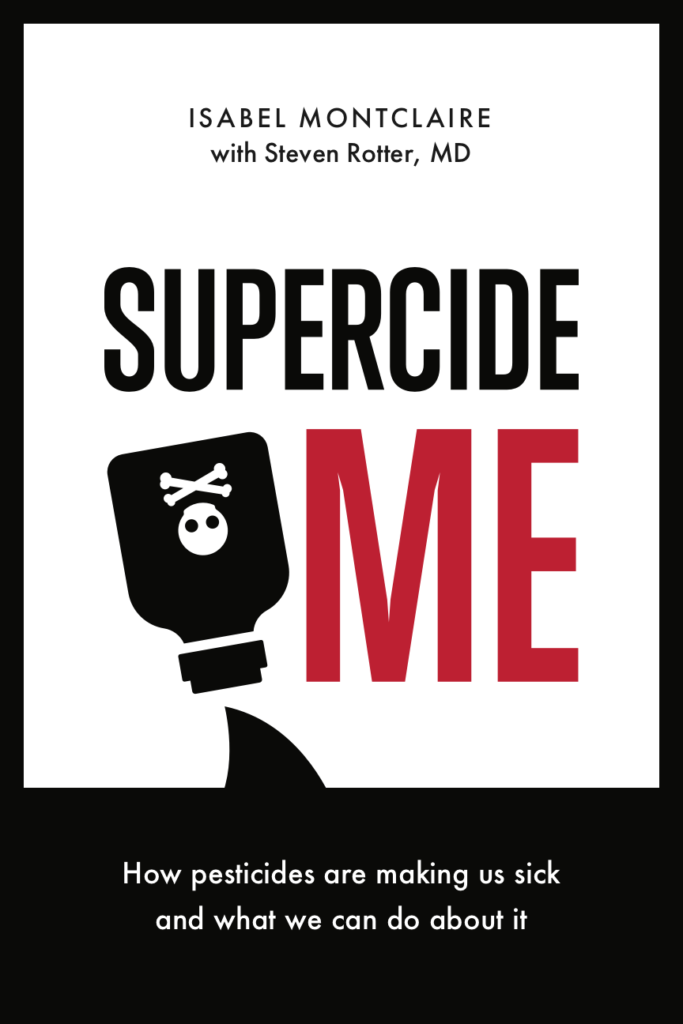
My physician, Steven Rotter, MD and I wrote a short, free, downloadable book called “Supercide Me: how pesticides are making us sick and what we can do about it”. Our goal was to quickly give readers the back story of the glyphosate/Roundup issue to expand their understanding of it. Then we will be better equipped to mobilize and create the kind of change we’d like to see. We are introducing a new word – “supercide” into the English language. This word describes the chronic, low-dose exposure to pesticide residues in food and the environment. This word will make it easier for people to talk about pesticides’ effects on health and to warn others about it. When you read this short book, you will understand why eating organic food has become mandatory, not optional. You can download it here: https://www.isabelmontclaire.com/books/supercide-me/
Please let me know how you like it! I’d love to hear
from you.
Something profound happened recently on my quest to make the
high-quality food necessary to maintain optimal health affordable for more
people.
One misty December morning, I was writing away at my desk,
tortoise Kat on lap and red china teacup in hand, wearing what I always wear
when I write: my long black velveteen housecoat, leggings, and a puffy down
jacket (I live in a cozy but sometimes drafty cottage). I hadn’t taken a shower
yet and barely combed my hair. From my desk I can peer out a small window that
frames the lane in front of the house.
That morning from my small window I see a sheriff’s car pull
up in front of the gate. Two officers step out of the car, and I step out onto
the porch. After brief and polite introductions, they inform me that they have a
warrant for my arrest.
Oh.
I was allowed to make one phone call (to my neighbor, “I’ve
been arrested, please feed Kat.”) I hurriedly put on my shoes, grab a coat and
my purse, am escorted to the car, put into handcuffs and buckled into the back
seat. The officers were firm but kind. I did not feel threatened or afraid; no
adrenalin was shooting through my body that I was aware of. Along the way, they
read me my Miranda rights.
After a twenty minute drive, we arrived at the county jail.
And there I had a razor sharp view into a world I had not ever seen up close
and personal, no, not in the bubble of my insulated life. A world I had been
increasingly curious about because it seems to be expanding in the landscape now.
I spent nearly thirty hours there (time crept by slower than
forever), going in and out of various cells, and talking with at least fifteen
young women, maybe more. These were some of the most beautiful women I have
ever seen, despite the fact that some had missing teeth, unkempt hair, scars on
their thin arms. Wearing our prison blues, there we were stripped down to our
raw, sincere and humble true selves.
Over and over, I heard different versions of the same story.
Of inmates who had suffered severe abuse or trauma as a child or young adult. A
friend offers drugs to ease the pain, addiction sets in. Somewhere along the
line they are abandoned by friends and family who have done all they can to
help and can do no more. Many have young
children, placed with relatives or in foster care. Some are homeless. Several
were there because they had missed a court date (which results in another
charge). I heard of the logistical difficulties a homeless person has of
getting to court. No money or a way to charge a phone to get a bus schedule.
The dialogue was sincere and honest. “Have you ever been in
love?”, a young woman thoughtfully asks. In a split second I wonder, “If I
thought I was, but then decided I wasn’t, does that count?” After a long pause,
I reply by saying “Yes, once, but he died.”
“My child was my only hope. And they took her away.” ”My
father murdered my mother when I was three.” “My mother drank when she was
pregnant; I was born with fetal alcohol syndrome.” “I was caught stealing food
after my food stamps ran out.”
An inmate going through withdrawal wails with piercing
screams. “Get the doctor!” But “medical”
is busy that day. I sit beside her, reassuring her that she is not alone,
feeling helpless like she does. Many inmates tell me they wish they could do better;
some are tired of the long wait to get into treatment facilities.
At night in a dorm with about 15 bunk beds, I attend a
Narcotics Anonymous meeting with four other inmates, all of us sitting on a
lower bunk. They want to know what I’m addicted to. After giving them the
annotated version of my story, one of them says, “Oh, it sounds like you are
addicted to helping people.”
I hadn’t thought of it that way.
No words describe the tenderness and care these women showed
to me during my stay there. The experience was rich with intense connection and
sharing. With no cell phones or other distractions such as superficial social
media, there was a certain level of presence that I don’t often experience in
my day-to-day life. Yes, I’ll take that.
Two days after I’m released, I’m driving down the freeway.
Suddenly a primal scream accompanied by a flood of tears gushes up from the empty
space deep inside of me. It’s explodes with that “hurts-so-good” kind
of pain. Am I the Grinch whose heart grew three times that day? And then found
the strength of ten Grinches more, plus two? Or am I the tin man, who knows he
has a heart because it is breaking?