In the wintertime, a lovely afternoon treat is to make a gingerbread cake. But I can hear you saying “Yeah, right. Like I’m going to drop everything in the middle of the day to bake a cake”. Yes, you can. Here is how: you cheat!
Here’s your cheat sheet:
One box gingerbread cake mix One 15 ounce can of pumpkin or 2 cups fresh pumpkin puree One egg One tablespoon molasses (light or dark, depending on how dark you like it) 1 tablespoon ginger
When using pumpkin, the moisture content can vary in consistency, so I recommend adding a tablespoon of water to the mixture. If it seems too dry, add another tablespoon or two.
You can also add other spices: cinnamon, allspice, nutmeg, or cardamom. I use a tablespoon of cinnamon and a generous ½ teaspoon of the others. Cardamom is expensive so I buy the seeds in bulk and grind them myself (a heaping teaspoon of cardamom in a pot of black tea is utterly delicious).
Mix all ingredients together with a fork, an electric mixer, or even your hands – think playdough. Put the batter in an oiled or buttered 8 x 8 pan or muffin tin. Bake in a preheated oven at 350⁰. Muffins will take about 35 minutes and a pan about 40. Ovens vary in temperature so yours may take a longer or shorter time than mine.
How will you know it’s done? A few cracks will appear on the top and it will start to pull away from the sides and when you insert a knife, no batter will be on it. And, you will smell the aroma. The fragrance will suddenly fill the room, as if the cake is shouting “I’m done!”
I like it best served warm. You can fancy this up by topping it with whipped cream and crystalized ginger. I like to sweeten the whipped cream with honey and vanilla (whipped cream sweetened with honey will stay whipped for several days). Or simply pour some cream directly on top of the cake. When topped with chopped crystalized ginger, it becomes special occasion food. Oh, you’re not having a special occasion? Sure you are, even if you are by yourself you can have a party for one. Think of something to celebrate and savor every bite. Crystalized ginger stores for years when kept in an airtight container.
Sometimes cheating is okay, especially if it warms your tummy. Using the cake mix saves you time but more importantly it inspires you to get in the kitchen. When you bake something on a cold winter day, this warms the kitchen and the aroma fills the house and your spirit.
Do you have a recipe for doctoring up a cake mix? If you’d like to share it, please send it to me at Isabel@plentymethod.org
I can make an extraordinarily delicious tomato soup in three minutes with three main ingredients and three things to wash. My friends and family often tell me it’s the best tomato soup they have ever eaten.
You will need:
28 ounces of canned tomatoes, either whole, stewed or cut. That is one big can or two 14 ounce cans. One onion, yellow or sweet Four ounces (one stick) of butter (I like the Irish butter Kerrygold, made from the milk of grass fed cows. I am fairly certain that the reason this butter is so good is that the cows are tended by leprechauns). Splash of vinegar (any kind except white distilled)
A slow cooker, pressure cooker or a saucepan.
Open the can and pour the tomatoes and the juice into a pot. Peel the onion and cut it into very large chunks (for those inclined to be accurate, cut it into sixteenths). Cut the butter into pieces then give the mixture a quick swirl.
If you use a slow cooker, cook it on high for about three hours. On a stove, simmer it for about half an hour, stirring occasionally. If you use a pressure cooker, 12 minutes should do it.
After it’s finished cooking, blend the soup. I use an immersion blender. If you use a standard blender, cool the soup, so it’s not steaming. If the soup is hot, when you remove the lid it will explode. The soup will go all over the place – the ceiling, walls, cupboards, the floor, your face, apron, and jeans. I should know – I have done this twice (and years later, there is still some soup on the ceiling; a friend pointed this out to me recently).
After blending, stir in a splash of vinegar. My favorite is white balsamic. White balsamic vinegar is also excellent on green salads that contain fruit. Aged sherry vinegar works well too. Other additions can be a tablespoon or so of Grand Mariner liqueur which adds a subtle orange flavor, or basil, either fresh or dried.
Add a grilled cheese sandwich on sourdough bread and you have a quick and easy meal that has a comfort food feel on a chilly central Oregon night.
Do you have a simple three-ingredient recipe you’d like to share? If so, please send it to me at Isabel@plentymethod.org
Parsley: For many people, it’s just a garnish on a dinner plate. Some people probably don’t even know they can eat it. But did you know that parsley is an under-rated nutrient-dense superfood, packed with many vitamins and anti-oxidants that promote enhanced immune function? Building up your immune system is vitally important now to shield us from a variety viruses and diseases.
Instead of focusing on what you don’t want to happen to your health, try focusing instead on what you can do to create vibrant health and aliveness. Eating parsley can fortify your body so it becomes strong and resilient. Our bodies have self-healing abilities, and are capable of defending against sickness. Sometimes we forget that.
If an apple a day keeps the doctor away, a bunch of parsley can keep two doctors at bay. How can you eat that much parsley and enjoy it enough to drink a glass several times a week? Easy, use a blender.
Start by getting a bunch of parsley and using scissors, cut it up over the opening of the blender. Cut up an apple and a banana, add some water and give it a whirl. The banana masks the taste of the greens, whether those are parsley, kale, spinach or watercress. If you’d like it sweeter, add a tablespoon or so of frozen orange juice or any other kind of juice.
Pour the drink into a clear glass so you can enjoy the vibrant green color as you sip your way to health. If you can’t drink it all, make sure you put it in an airtight container and drink it within a day.
I buy several bunches of parsley and freeze them in Ziploc bags. This way you will always have an ample supply on hand. I find the psychological benefit of drinking this several times a week is huge, because whenever the thought of sickness crosses my mind I remind myself “I ate my parsley. I am healthy, strong and resilient.” Not only is parsley good for your health and mind, it can make your complexion glow too.
Think of this green elixir as low cost inner peace and protection in a glass. The best part of making this parsley drink is you can you make it the way you like it. You can add kiwi, grapes, cucumber or celery too. Next time you are at a restaurant, don’t forget to eat the parsley!
By now, you may have heard the news that the Environmental Working Group (EWG) tested 21 oat-based foods and they all tested positive for the Roundup/glyphosate pesticide. The real tragedy of this is that many of these foods are fed to children whose detoxification systems are not yet fully developed so the health effects are much worse for them than adults.
The EPA responded a day later to the EWG’s findings, but they left out some important parts of the story. I wrote what they aren’t telling the public in brackets. Here is their statement:
“EPA has established a tolerance (maximum legal residue level) for residues of glyphosate in oats at 30 parts per million (ppm) or 30,000 parts per billion (ppb). The EWG samples listed in the linked article are all well below the EPA tolerance. Residues of glyphosate on any food or feed item are safe for consumers if they are below the established tolerances. The presence of a detectable pesticide residue does not mean the residue is at an unsafe level.” [Never mind that the EPA has raised the glyphosate tolerance level allowed on oats to now be 300 times higher than it was in 1993.]
“Due
to its widespread use, trace amounts of glyphosate residues may be found in
various fresh fruits, vegetables, cereals, and other food and beverage
commodities. However, these trace amounts are not of concern for the consumer.”
[New scientific studies show that even trace amounts of glyphosate can
disrupt the endocrine system and gut microbiome, and is strongly linked to
fatty liver disease and diabetes, just to name a few.]
“If residues are found above the established tolerance level, the commodity will be subject to seizure by the government.” [But they only test four foods! The USDA and the FDA are the regulatory agencies responsible for monitoring the pesticide residues in our food. The FDA conducts tests for the residues of hundreds of pesticides via its Pesticide Residue Monitoring Program. But prior to 2016, the FDA didn’t test for glyphosate residues (and only then due to enormous public pressure).[1] In the most current report (2016) only corn, soy, milk and eggs were tested. The USDA annually tests hundreds of foods for pesticide residues through their Pesticide Data Program. But as of 2017, they do not test foods for glyphosate residues, a notable omission.[2] That’s why organizations in the private and non-profit sectors are now testing foods for glyphosate residues, to fill in the gap. Here is the link to the FDA’s explanation about why they did not test for glyphosate prior to 2016: https://www.fda.gov/food/pesticides/questions-and-answers-glyphosate]
“EPA has concluded that glyphosate is not likely to be carcinogenic to humans. EPA considered a significantly more extensive and relevant data set than the International Agency on the Research for Cancer (IARC). EPA’s database includes studies submitted to support registration of glyphosate and studies EPA identified in the open literature.” [Most of those additional studies were funded by the chemical companies and were not available to the public. Studies paid for by the agricultural chemical companies are fundamentally biased. The IARC used only publicly available, peer-reviewed studies conducted by independent experts who are free from vested interests.[3]]
“EPA’s
cancer classification is consistent with other international expert panels and
regulatory authorities, including the Canadian Pest Management Regulatory
Agency, Australian Pesticide and Veterinary Medicines Authority, European Food
Safety Authority, European Chemicals Agency, German Federal Institute for
Occupational Safety and Health, New Zealand Environmental Protection Authority,
and the Food Safety Commission of Japan.” [Regulatory
agencies are often infiltrated by high level executives who were once employed
by the agricultural chemical companies. These executives can then make the rules,
such as 1) not monitoring Roundup/glyphosate residues in food and 2) raising
the allowable limits. These rules allow the chemical companies to declare that
the public is safe from health impacts even in the face of increasing evidence
that public’s health is at risk.]
If you doubt the truth of what I am saying here, please read the paper, “Supercide Me”, free and downloadable on our website: https://www.isabelmontclaire.com/books/supercide-me/. My physician, Steven Rotter, MD and I explain the untold part of the Roundup/glyphosate story and include links to credible primary source documents. And I highly suggest you open and scan the links to the FDA and USDA reports included here, to get a general idea of the huge number of pesticides applied to our food. These will make for good reading in the morning while you eat your oat-based breakfast cereal. Just suggestin’.
The EPA raises the amount of Roundup/glyphosate allowed on our food as the amounts farmer’s use rises. The vertical red lines denote the rise in the allowable amounts since 1993 and the yellow background shows the rise in the amount of glyphosate that farmers use. Chart created by Politico Pro.
The amount of plastic the world consumes has increased
dramatically since 1980 and 40% of it is used just once. (National
Geographic, June 2018) The majority of this plastic comes from food
packaging. The next time you are in a grocery store, take a look. Notice all
the single use packaging then envision it ending up in the landfill. It’s
actually somewhat horrific when you step back and really see the stark truth of
this.
The Plenty Method can help you reduce your plastic footprint
and food packaging in general. How does it do this? First, food is made from “scratch”
ingredients that are bought in bulk
whenever possible. You learn that it’s actually quite easy to make something simple
and delicious out of scratch ingredients so you purchase less and less packaged
food. And when you buy food in bulk, more of your money goes to buy the food,
and not the packaging, so you’ll be able to buy higher quality food. Your
pantry will be full of nutrient dense, whole foods that are usually organic. I
call this “superstar food”. It stands on its own and doesn’t need much “do” to
prepare so putting food on the table is quick and simple.
Each of these scratch ingredients has its own airtight container or other permanent location. This makes working with food so much more pleasurable. The airtight containers replace all the food stored in single use, mismatched packages that don’t seal properly, which may invite staleness and attract bugs, moths, mold, mites, and rodents. It’s much nicer to handle a substantial glass jar that opens easily than flimsy single-use packages that usually don’t close properly. You can see the food through glass jars which is visually more pleasing than a collection of opaque food packages. Your food will be clearly visible and labeled. No more “UFO”s – Unidentified Food Objects! You can say goodbye to random food clutter. The kitchen stays clean, organized, and fresh.
Together, we can stop this crazy overuse of plastic. Every little bit helps and small steps can add up to radical change. Transformation starts with awareness. Just say “no” to single use packaging, one buying decision at a time. This will make a world of difference and a different world.
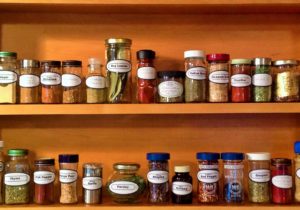
Spices can be bought in bulk and stored in jars retrieved from recycle bins
One of The Joy of Plenty’s goals is to help reduce the amount of food the world wastes. Every day America wastes enough food to fill the Rose Bowl. Yes, that Rose Bowl—the ninety-thousand-seat football stadium in Pasadena, California.[1]You read that right; that’s every day, not every year. The Natural Resources Defense Council claims Americans lose up to 40 percent of our food from farm to fork to landfill.[2] Reducing the amount of food waste (or, waste as food) will dramatically help create planetary health since agriculture leaves a huge footprint on our planet.
While The Plenty Method can’t do anything about the food that rots in a farmer’s field or deteriorates in a warehouse, it can help you trim your household food waste. How does The Plenty Method do this? By helping you learn how to:
Purchase
Make a focused Master Ingredients List that encourages you to purchase fewer but more versatile kinds of food. Less variety leads to less waste. Creatively transform the ingredients you already have on hand instead of buying a new single-use item that could end up as half-eaten food waste.
Buy food close to the source so it is fresh and lasts longer.
Buy longer-lasting foods instead of those that rapidly spoil.
Store
Learn how to store food properly to prevent premature spoilage.
Store and preserve food properly, then retrieve it from storage as
needed. This is a flip-flop from buying food, thinking that you will use it,
but then your plans change. You forget the food; it spoils and gets tossed.
Store staple ingredients in clear, airtight glass containers so
they are visible; no out-of-sight, out-of-mind food left to rot.
Learn to extend the life of food by removing oxygen by using a
vacuum-packing machine and other methods.
Sense
View manufacturer’s expiration dates as suggestions only; tune
into your senses to determine if a food is safe to eat.
Understand the shelf life of foods to know when to watch for
subtle changes in flavor, texture, and smell that tell you to use it soon.
Connect
Experience more connection with your food by learning to
appreciate and respect it. This awareness encourages you to tune into your food
to prevent spoilage.
Share or exchange food with others before it spoils.
Use
Use or preserve avoidable waste, such as peelings, meat bones, and
overripe fruits. For example, freeze cream in ice cube trays. Use old bread for
breadcrumbs, croutons, French toast, or bread pudding. Transform carrot tops
into carrot-pesto. Use Parmesan cheese rinds to flavor soups, and so on.
Redefine what fresh
means, and resurrect foods that are thought of as “bad.” For example, a
cauliflower with brown spots is usually perfectly edible when you trim them
off. A mealy apple is delicious when you bake it. Try putting a soggy banana in
a smoothie or banana fritter.
Please consider learning The Plenty Method to reduce your
household food waste. Every little bit helps! Or, as I like to say “Big is
just a whole bunch of little”. One small step, one small footprint can add
up to huge progress down the road. One person can make a difference and that
person is you!
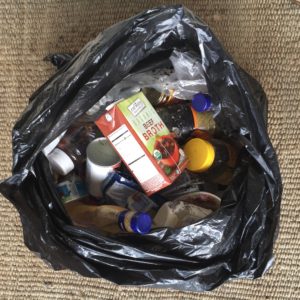
Half-eaten and expired condiments create alot of wasted food
[1]
Jonathan Bloom, American Wasteland: How America Throws Away Nearly Half of its Food (and What You Can Do About It)
(Cambridge, MA: Da Capo Press, 2010), xi
I am so thankful
for the bees ‒ the fragile agents ‒ who work tirelessly on our behalf. Much of
our food chain depends on pollinators, yet many people are unaware of the
essential role they play in creating our food supply. Part of The Joy of
Plenty’s mission is to educate people about the role pollinators play in food
production and to sound the alarm about the enormous pressure all pollinators
are under from overuse of agricultural pesticides.
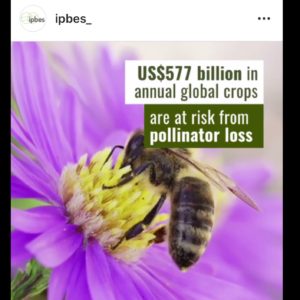
Last week, the United Nation’s Intergovernmental Science-Policy Platform on Biodiversity and Ecosystem Services (IPBES) released a report on the current state of the biosphere (please see previous post). The report estimates that up to US$577 billion of the crops the world produces are at risk without bees to pollinate them. Bees are the linchpin of our food system and overuse of agricultural pesticides are one of the reasons they are weakening.
In a perfect world, if everyone ate organic food, the need for toxic agricultural chemicals would diminish and this would greatly help the bees. The Plenty Method gives people the tools they need to increase their purchases of organic food, so they can eat well and support the pollinators, too. Over time, this will help foster a robust food chain and vibrant ecosystems, and we can do this now. In a landmark decision in May of 2018, the European Commission banned three neonicotinoid insecticides linked to bee death. This is an encouraging sign that vast numbers of people are becoming aware of the need to protect our pollinators and it’s a huge win for the bees. We can join the crescendo of voices that created that legislation and add to the momentum. Our collective buying power can create massive transformation, one buying decision at a time.
Please consider using The Plenty Method to spend your food dollars wisely and well and to help protect our food supply for future generations. As I conclude writing this, the Beatles song “With a Little Help From My Friends” repeats in my inner ears. But I’ve added a word! “I get by with a little help from my little friends.” Dear bees, what true friends you are. You are our unsung heroes! Let’s join together to give them all the help they need.
I heard shocking and urgent news recently, back to back. Five days later I am still trying to figure out how to respond to this unfolding story. Even though much of the news makes me feel as if I just got sucked into a dangerous abyss, there are still robust moves we can all make. All is not lost, if we work together to help one another.
The first news was the summary of a soon to be released 1,500 page report authored by the United Nation’s Intergovernmental Science-Policy Platform on Biodiversity and Ecosystems Services (IPBES). It’s official! We are now facing our planet’s sixth wave of extinction with over one million species of plants, animals and insects potentially on the block, and soon. Sounds like a holocaust to me.
The next news arrived in the
May/June issue of the MIT Technology Review. The cover says “Welcome to Climate
Change”. For those of you who may be unfamiliar with this publication, MIT is
one of the world’s premiere scientific think tanks. Whatever topic they discuss
is validated by credible research and fact-based evidence so the publication is
reliable and trustworthy. They discuss science and technology in the context of
its sociological, cultural, economic and political context. Much of the discussion
of climate change currently centers on how we can avoid it. We remain hopeful and
comforted about technology’s romantic and futuristic ideas about how to avoid
climate change but it’s no longer possible. We entertain ideas about mitigation
measures such as engineering the atmosphere and carbon capture. But the
magazine says it’s time to “get real” because the momentum of climate change is
too swift, even if we were to slam the brakes on it now. Truth is, global
temperatures and emissions are rising, not falling. A big chunk of the Arctic’s
oldest and most stable sea ice recently broke off. We’ve made no dent in the
use of fossil fuels. And on and on the list goes. So, time to shift the
dialogue to understanding how this new, catastrophically altered world will
look and how we will adapt.
Why do they suggest shifting the
focus more towards adaptation? Because efforts to transform this situation will
not likely be successful fast enough. The first world countries are too busy
and distracted to notice or care and they hyper-consume. The populations in third
world countries are exploding so that will be a huge drain on planetary
resources. Repeated attempts have been made internationally to create a cohesive,
long-term global vision and plan of action. Yet commitment among most countries
is notably absent. I add to this, that many powerful multi-national corporations
have deeply vested interests in maintaining the status quo. Unfortunately, the
tragedy is that by the time climate change is obvious to everyone, it will be far
too late.
What to do, or not do, then? How
do we still enjoy the life that is before us and keep our optimism alive? While
the United Nation’s report was dreary and startling, they say “Nature can be conserved, restored and used
sustainably while simultaneously meeting other global societal goals through
urgent and concerted efforts fostering transformative societal goals –
including those for food, water, energy.” Those of us who see what is coming
can show up, stand up and hold together with heart, courage and commitment. Those who are uncertain can gradually join in.
Amid all this uncertainty, one thing is for certain: this situation will be far
easier if we take a joint approach rather than a divisive one. This holds true
whether we avert the crisis or adapt to it. Think of it this way: we have an
opportunity to witness breathtaking transformation here, regardless of the
outcome.
As I write this, I look out my
window and see drooping tulips whose early spring time vigor has waned yet
their beautiful deep red is still extraordinary. A blue jay rests on a nearby
fence, iridescent in the evening light. These, along with the yellow pepper on
my plate create a palate of primary color that is indescribable to behold. In
this moment, embraced by the beauty of Mother Nature, I am nourished and at
peace. No matter how ominous the long term picture may look, it’s always easy to
find something to appreciate. We don’t need to sit in the bottom of an utterly
dark abyss. If we do that, we can’t see,
appreciate or protect the cornucopia of gifts our beautiful planet constantly gives
us. Why
not visualizethe sudden enlightenment of the world
instead?
If you’d like to know how The Joy of Plenty can help you make a contribution to the creation of planetary health and relieve your anxiety about its current state, stay tuned for the next series of blog posts. Look below for a link to the summary of the United Nation’s IPBES report.
Here’s another example of an un-recipe. In case you haven’t read any of the prior posts, an un-recipe gives you enormous freedom in the kitchen. You can break free from having to use exact ingredients and exact measurements, too (baking is an exception, there is some leeway but not much). You learn to switch out and switch up ingredients in recipes and use what you have on hand. This makes the whole topic of food easier and more pleasurable. Over time, you learn which flavors go together and you will discover unique combinations you didn’t even know existed. If you want information about which flavors compliment each other, check out “The Flavor Bible” by Andrew Dornenburg and Karen Page.
The following un-recipe is for my favorite quick bread. I love eating this in the morning, toasted with a lot of butter. Eating something this delicious —and nourishing —makes me happy to be alive. The quality of one’s life can be measured in the number of simple little pleasures that occur throughout the day. You don’t even need a mixer to make this – just a mixing bowl, spoon, and some elbow grease.
The Very Best Quick Bread or Muffins
2 cups unsifted flour (I’ve tried this with gluten-free flour, it works as long as you add some xanthan gum) 1 tsp baking soda ½ tsp baking powder ¾ tsp salt Sweetener: 1 cup date, coconut or cane sugar. I like to use date sugar. If you use coconut sugar, keep an eye on it because it will brown fast. Cover with foil about 15 minutes into the baking. This recipe may work with honey or agave syrup, but I have not tried it. You might need to add a bit more flour. Spices: ½ tsp each cloves, nutmeg, cinnamon and ginger or 2 teaspoons pumpkin pie or chai spices or other combination of warm spices. 2 eggs ½ cup vegetable oil (I like to use rice bran oil) OR substitute ¾ cup mayonnaise and ¼ cup water for the oil and eggs 1 ½ teaspoons vanilla or other flavoring (I like maple, almond and hazelnut) 1 cup pumpkin or winter squash, or mashed ripe bananas, applesauce, zucchini, or other pureed fruit. Chopped nuts and/or dates, candied ginger, chocolate chips, etc.
Combine the dry ingredients. Combine the moist ingredients then thoroughly mix the dry with the moist. Pour into greased loaf or muffin pans. You can vary the size of the loaf or muffin pans– just make sure they are filled about half way. Bake in a 350⁰ oven for 35-40 minutes or until the mixture starts to pull away from the edges of the pan and cracks appear on the surface. Cool in pan. This bread freezes well, too.
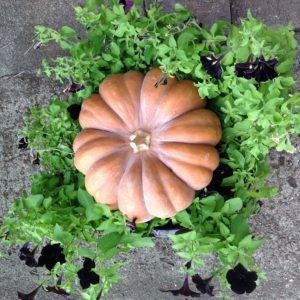
Heirloom pumpkins make fantastic pumpkin bread!
I like to make this via the “assembly line” method. You can make multiple batches of the dry ingredients and store each batch in one quart mason jars. Then all you have to do is round up the moist ingredients and whip a loaf together in just a matter of minutes. So there you go – another un-recipe recipe.
When you do The Plenty Method, you discover new freedom in
the kitchen via “un-recipe recipes”. You’ll have a pantry packed full of scratch
ingredients, called Master Ingredients, and a nice assortment of “flavor bursts”
– concentrated flavorings that up-level your cooking from good to great. The variety
of foods you keep on hand is dialed back – less is more in the case of your
pantry – and immense creativity and ease arises out of this simplicity.
Most recipes call for exact ingredients and measurements.
This can be quite restrictive and following recipes exactly is time consuming,
too. They can also lead to excessive food clutter. Recipes often call for ingredients
that you may never use again, so they tend to end up as food clutter then food
waste. Using un-recipes avoids this. When you read recipes that call for ingredients
you don’t have on hand, you learn to make substitutions with what you do have. If
you are using “The Plenty Method”, your well thought out pantry gives you many
options. A simplified yet plentiful pantry
takes much of the complication out of putting food on the table.
Here is an example of an “un-recipe recipe” – my favorite
salad dressing. Why is this an un-recipe? Because you can mix and match the ingredients
and create many versions. Over the years many friends have asked me for this
recipe and I am happy to share it with you now.
The Very Best Salad Dressing
½ cup vinegar (l like aged-sherry, champagne, white and red balsamic) 1 tablespoon sugar (I use raw cane and demerara) I tablespoon mustard (favorites are stone ground, Dijon and spicy brown) Pinch of salt (any kind but iodized. It tastes terrible!) 1 shallot (if you don’t have one, use about ¼ cup diced any kind of onion) 1 clove garlic 1 ½ cups oil (my favorites are olive, walnut, rice bran)
Puree the first six ingredients in a blender. Then slowly
add the oil and blend some more. Store in a glass bottle. Keeps for up to two
months, refrigerated.
Lately my favorite version of this is made with sherry
vinegar and half olive/half walnut oil and stone ground mustard. In the past I’ve
used blood orange champagne vinegar. White wine vinegars are better with neutral
oils, like rice bran (please see previous post) and dark vinegars are better with
olive oil.
Make your own salad dressing with the best vinegar you can afford and increase your sensory pleasure and enjoyment of life!
So look at what you have on hand and whip up a batch. Once you taste this, pre-made dressings you buy at the grocery store will utterly pale in comparison. I use the money I save by NOT buying pre-made salad dressing to buy high-quality vinegar and oils. It takes just a few minutes to whip this up and the extraordinary sensory pleasure you’ll get makes the time spent so worthwhile. So there you have it – a real “un-recipe recipe”.